

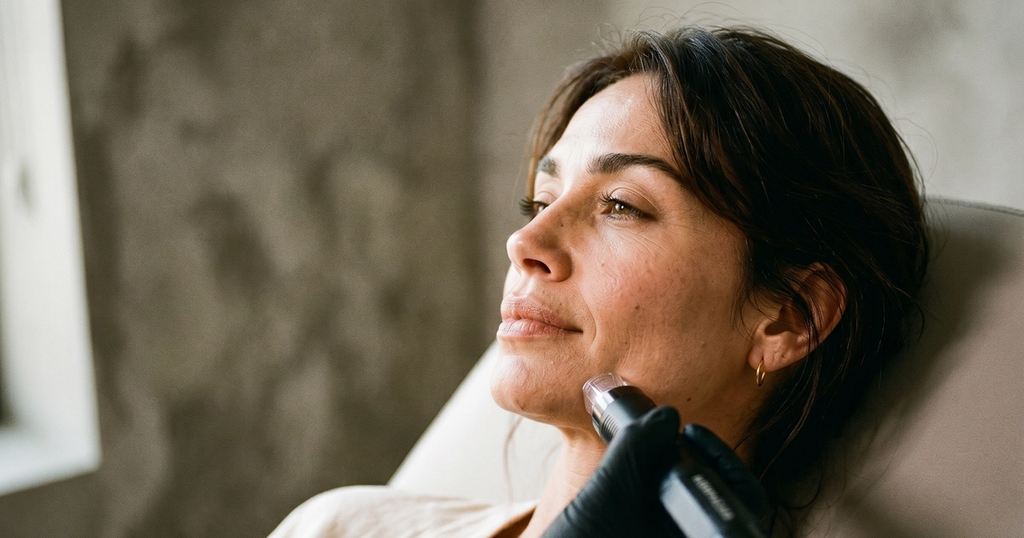
If you are searching for Morpheus8 in Montreal, you have probably read that it is revolutionary or that it transforms skin. Neither description helps you decide much. What most people actually want to know is whether it works, for whom, and what the experience is like. Here are straightforward answers.
What Morpheus8 is
Morpheus8 is a medical device that pairs two technologies: microneedling and fractional radiofrequency. During a session, fine needles enter the skin at a precise depth, between 1 and 8 millimetres depending on the area, and deliver thermal energy into the underlying tissue at the same time.
That controlled heat causes existing collagen fibres to contract immediately and triggers a regeneration process that continues over several weeks. The body responds by producing new collagen and elastin, which gradually improves skin texture and firmness.
What separates Morpheus8 from standard microneedling devices is how deep it reaches. It penetrates into the superficial fat layer, just below the dermis. That is where volume and contour changes happen, which surface treatments cannot address.
What Morpheus8 treats
The device is used mainly for:
- Mild to moderate skin laxity, particularly on the face, neck, and upper chest
- Uneven texture and enlarged pores
- Fine lines and shallow wrinkles
- Certain types of acne scarring, depending on the kind and how long they have been there
- Skin laxity on the body, including the upper arms, thighs, and abdomen
It is not a substitute for plastic surgery. For significant laxity or major volumetric changes, other approaches are more appropriate. A physician can assess what Morpheus8 can realistically do in your case.
What a session involves
Before the session, a topical anaesthetic cream is applied for about 30 to 45 minutes. This reduces sensation, though intense warmth and mild pressure remain noticeable. The session takes 20 to 40 minutes depending on the area. Some areas are more sensitive: the jawline and neck require a bit more patience.
Right after the session, the skin is red, slightly swollen, and sometimes marked with small dots where the needles entered. That is expected. Most patients return to normal activities within 24 to 48 hours.
What to expect in the days after
- Redness lasting 24 to 72 hours
- Mild swelling, often more noticeable the morning after
- Small surface crusts that shed on their own within a few days
Sun protection is not optional during recovery. The skin is more vulnerable to UV for at least two weeks after treatment.
How many sessions, and when results appear
It depends. Most protocols involve one to three sessions, spaced four to six weeks apart. Some people see a noticeable improvement after one session. Others, especially those treating greater laxity or acne scarring, benefit from a second or third round.
Results are not immediate. A visible improvement in texture typically appears around three to four weeks in. Firmness and contour changes tend to emerge between three and six months after the final session. Results can last one to three years depending on the skin, the patient's age, and how skin care is maintained.
Who Morpheus8 suits
The treatment works across a wide range of skin types. Unlike some ablative lasers that carry higher risks on darker skin, Morpheus8 is considered safe across Fitzpatrick skin types I through VI, which matters for the diversity of patients seen in Montreal.
Certain situations call for a thorough medical evaluation first: pregnancy, metal implants in the target area, active inflammatory skin conditions, or medications that affect photosensitivity. That is precisely why every Morpheus8 session at La Clé begins with a physician consultation.
What to expect at La Clé, in Old Montreal
La Clé is a physician-led medical aesthetic clinic, under the direction of Dr. Hadi Krayem, at 204 Notre-Dame Street West, in the historic heart of Old Montreal. A physician evaluates your skin, discusses your goals, and selects the parameters suited to your situation. Depth, energy level, and the number of passes are adjusted for each individual.
If Morpheus8 is not the right fit, the consultation will say so clearly. Other approaches, such as Lumecca IPL, skin boosters, or chemical peels, may be more appropriate. For more detail, visit the Morpheus8 treatment page.
This article was reviewed by the La Clé clinical team.
To find out whether Morpheus8 is right for you, book a consultation on our contact page.
La Clé clinical team
Frequently asked questions
Is Morpheus8 painful?
The session starts with a topical anaesthetic cream applied for about 45 minutes. Most patients describe the treatment as manageable. Intense warmth is noticeable during the pulses, but sharp pain is uncommon when preparation is done properly.
How many sessions does it take?
It varies. For mild to moderate facial laxity, one to two sessions often suffice. For acne scarring or more significant laxity, two to three sessions spaced four to six weeks apart tend to produce better outcomes.
Is there downtime?
Most patients return to their usual activities within 24 to 48 hours. Redness and mild swelling are the most visible effects in the first few days.
Is Morpheus8 safe for darker skin tones?
Yes. Fractional radiofrequency delivers its energy independently of melanin, which makes it safer than ablative lasers on higher phototypes. A medical evaluation beforehand is still necessary.
How long do results last?
Generally one to three years. Natural aging continues, and maintenance sessions are often considered after the first year. Regular sun protection helps extend results.